
“It’s both sensual and anonymous and I felt there was a lot of potential here for a story”
Close Enough to Touch writer Henry Roberts talks about his new play, the joy of theatre and why we need to tell different types of stories on stage.
Can you tell us a bit about Close Enough to Touch?
It’s about a man who’s essentially looking for some direction, who’s a bit lost. He’s looking for a job and he’s looking for his identity, and he finds some sort of identity in the world of cruising. The play is essentially about him discovering that world and finding pleasure in it, but also the consequences of keeping secrets from others in his life and keeping secrets from himself. The play is asking us, how do our inner desires sit with the person we outwardly present to the world?
Why did you want to tell this story?
I love stories which take you into a world you don’t know about, and I think for the majority of the audience watching this will be a totally unknown space.
I wanted to write it because I thought it was a really interesting topic and I’m fascinated by the contradictions inherent in cruising – it’s something so deeply intimate, yet it takes place in a very public space. It’s both sensual and anonymous and I felt there was a lot of potential here for a story.
The broader reason is I was frustrated by the lack of nuance in sexuality on stage. Plays about sexuality often don’t embrace the contradictions within us, and I was really interested in exploring these aspects of who we are which aren’t so easy to explain, or perform. I wanted to look at elements of our personalities that may contradict how we feel about ourselves and how we describe ourselves. So Close Enough to Touch came out of all these things.
“It’s both sensual and anonymous and I felt there was a lot of potential here for a story”
Why did you want to make this a one-person play?
In my mind it was always a one-person show. I really like one person performances – they’re almost like a whisper, or a bedside conversation, and there’s something beautifully intimate about that. Yet at the same time that closeness can be uncomfortable at times, and that apparent contradiction is fascinating to me.
I also find the idea of following a single protagonist, whether it’s a play or a film, really interesting. We only see the world as it’s presented to us by this person and during the course of the play, in this case, we start to question the narrator, we see the flaws in their personality and the flaws in the story they’re telling. The audience watches him making mistakes but they’re powerless to stop him making them, and that’s something else I find quite compelling.

L-R Actor Stefan Race and writer Henry Roberts discussing Close Enough To Touch in rehearals credit Mark Ratcliffe
What can you tell us about your protagonist?
We just know he’s a man in his mid-20s, and that he’s from the North of England and he now lives in London. Everything else we find out through the performance.
Without giving too much away he’s looking for a sense of identity. Yes, his sexuality is important and he’s looking to define his sexuality, but he’s also looking for a way to define himself. He’s unemployed when we meet him at the start of the play, and he doesn’t really know what he is and why, or what he wants to do. He’s quite a weak character in a lot of ways. He’s very passive, and his decision to enter the world of cruising is one of the first active choices he makes.
For all the play’s heavy themes, it is meant to be funny in places and I hope people do warm to him, despite all the mistakes we see him make. I actually have a lot of sympathy for him. Part of me wants to hold his hand and guide him through life, and other times I just want to shake him by the shoulders because he keeps getting things wrong.
How did you end up working with Red Ladder and Silent Uproar?
I did a shorter, non-professional version of Close Enough to Touch a couple of years ago which I took around London. Then I was offered the chance to take it to the Lancashire Fringe Festival. I thought that would be the final performance and then I’d say goodbye to it.
As I always do, I invited people to come along and as part of this I reached out to Red Ladder. They couldn’t make it but they asked if they could read the script so I sent it to them. I didn’t expect to hear back but then a few months later they replied, asking if they could use the play for a student scratch night. I said ‘yes’, again without any expectations of what might come from it, and afterwards they said they really liked it and commissioned me to produce a full length play alongside Silent Uproar.
I’m really grateful to both companies for believing in me and championing the piece. I always believed in the story but there are times when you’re playing in tiny venues to small audiences when you think, is this the end of the road? So to have this support was a real confidence boost.
Can you tell us a bit about your story and why you wanted to be a playwright?
Fiction was my first love, but in terms of theatre my earliest memories are going to the pantomime every year as a child. We’d go on school trips to the Bolton Octagon, and every year I’d go with my mum to Manchester and watch A Christmas Carol. Going to the theatre as a child represented joy. It was something to look forward to. It was a place to escape to.
Later I became the stereotypical, pretentious teenager writing poetry and plays and short stories, which were awful and I hope they never see the light of day! I loved writing but I didn’t think I could possibly do it as a career. I was never discouraged from doing it, but to me being a playwright was something that other people did. So instead of doing creative writing or something like that, I studied international relations at university with the idea of working for an NGO, though I spent all my time doing plays rather than studying!
“Going to the theatre as a child represented joy. It was something to look forward to. It was a place to escape to”
Is Close Enough to Touch a queer story, or do you feel it has broader appeal?
Certainly on one level it is a queer story. This is a story about sexuality, identity, desire, shame, but also pleasure – and these are all very queer themes. So in this sense it’s a queer story. But it’s also about what we think we want versus what we actually want, and the contradictions between our public and private selves – all pretty universal themes. I hope it resonates with any straight person watching it, and they would think about how it connects to their own lives. So for me, it’s a broader story.
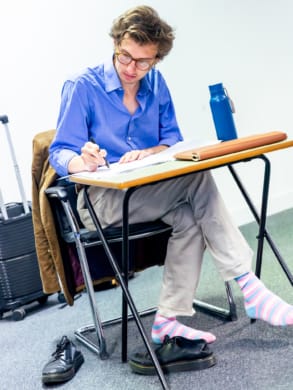
Henry Roberts in rehearsals credit Mark Ratcliffe
Why is it important that stories like this are told on stage?
We need all kinds of stories because we make sense of ourselves through the stories we’re exposed to. Seeing a good play can be a really cathartic experience.
It’s live, it’s intimate and it’s ephemeral – you never get the same performance twice. You can create a beautiful connection between the performer on stage and the audience. That’s all true and it’s why I write for theatre.
At the same time, I think that a theatre needs to be a space where we can address uncomfortable truths and explore contradictory ideas. We are all complex, messy, ambiguous creatures, and I believe by exploring our darker sides we understand ourselves better, and I think theatre is a really good art form for that.
Why is theatre still an important form of entertainment?
I think it’s probably fair to say that theatre, in some form or another, is the oldest art form there is. Long before we started building what we might recognise as theatres, we’ve been telling stories, back when we were hunter gatherers. Telling stories and listening to them goes to our bones and sits within our DNA.
There’s an intimacy with theatre that you don’t get through a screen. I’m not arguing against digital media because I love it, but the theatre speaks to a real human need for connection and communal activity that goes back thousands of years to when we sat around fires listening to stories.
“We are all complex, messy, ambiguous creatures, and I believe by exploring our darker sides we understand ourselves better, and I think theatre is a really good art form for that”
What do you hope audiences take away from the play?
I believe that a playwright’s primary job is to entertain. So although the play does explore darker themes there are jokes and funny moments. I think it goes back to being a child at the pantomime and seeing the curtain go up and knowing that you’re in for a good time. And I hope that’s what people feel when they watch this.
You can book tickets for ‘Close Enough To Touch’ now.
Henry is a writer, playwright and photographer. Originally from Lancashire, he is now based in London. In 2025 and 2026, he was longlisted for The Observer / Anthony Burgess Prize for Arts Journalism. Henry’s plays have been performed at Theatre503, Riverside Studios, Camden People’s Theatre and other theatres in London and Edinburgh. He was a member of the Young Vic’s 2022 cohort of young theatre-makers and was longlisted in the RSC’s 37 Plays project for Close Enough to Touch. Henry’s new one-person play Close Enough to Touch, a co-production between Red Ladder and Silent Uproar, goes on tour across the UK this autumn.