Amplifying the voices of refugees and asylum seekers
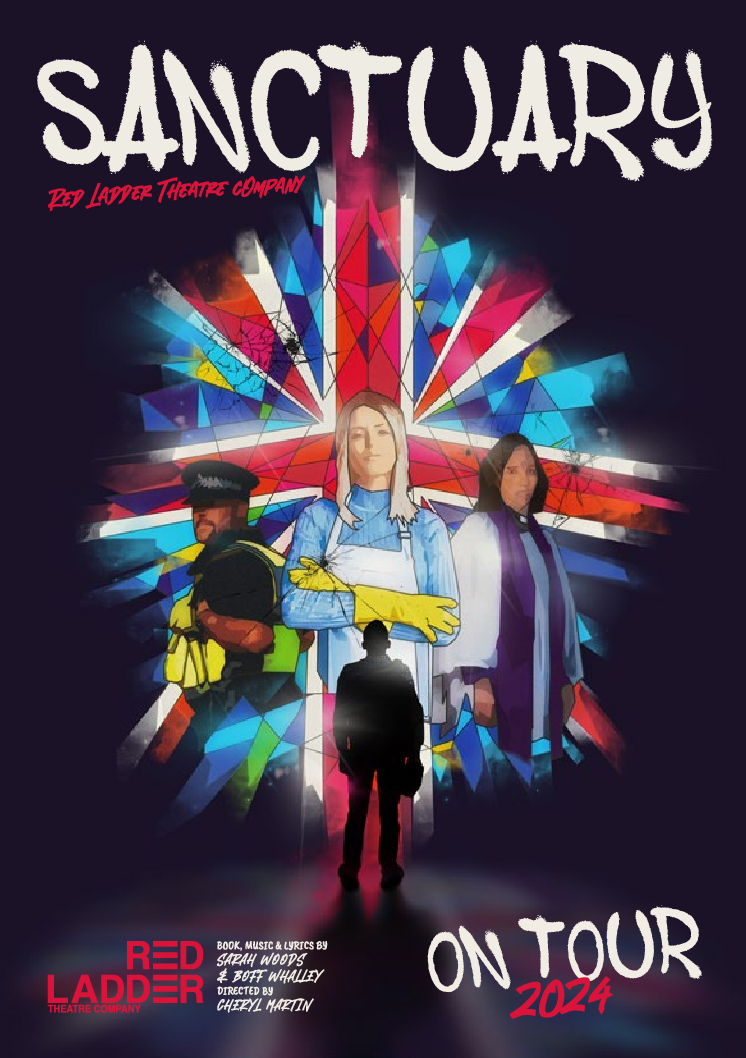
I didn’t choose Sanctuary for my first production as Red Ladder’s Artistic Director, I inherited Boff Whalley’s and Sarah Woods’ brilliant and compelling new musical from my predecessor, Rod Dixon.
But even though I didn’t choose this play, which tells the story of a young Iranian man whose plea to be given sanctuary at a church in northern England divides the local community, if I could have picked a topic then this is one I would have gone for. Why? Because I think it’s hugely important and goes to the heart of the kind of society we want to live in.
Now that Rishi Sunak has finally called a general election, the political spotlight has focussed once again on immigration (has it ever gone away?) as politicians vie with one another to talk tough on the issue with promises of crackdowns, tighter border controls and so on. It feels like refugees and asylum seekers have become political punch bags and their experiences ignored in favour of sensationalist and often inflammatory headlines.
Whenever we hear about an immigration story in the news it’s often negative and usually focuses on numbers and statistics, rather than real people with poignant, and often heartbreaking, stories. If a boat carrying migrants across the Channel sinks and those on board drown we rarely hear about the lives lost, or the devastated families left behind. Instead, it becomes a game of political finger pointing with yet more tub-thumping rhetoric.
But I believe the stories of people who come to our country seeking our help and protection deserve to be told – and we need to hear them. During my time working in Manchester I collaborated with Community Arts Northwest on a series of big community plays devised with, and starring, mostly women refugees and asylum seekers. So I know from personal experience the positive impact this can have not only for those involved, but the audiences too.
Art and culture, whether it’s a play, a novel, or a film, has such an important role because they highlight our common humanity and can help change people’s perceptions. A lot of the asylum seekers and refugees I worked with had highly skilled jobs back in their own countries. They were doctors, teachers and chemists, and most of them were forced to flee their homeland because they spoke out or protested in favour of democracy, free speech, or equal rights.
They came from places like Iran, Afghanistan and Syria, and they left because they had little or no freedom. I’m in awe of these people and in another world Hollywood would be making movies about them and portraying them as heroes. They stood up for what’s right and what they believe in despite being threatened with violence or persecution – that’s a hero’s story in my book.
It’s good for us to put ourselves in other people’s shoes and question our own perceptions and biases. Theatre is all about exploring what it is to be human: it’s far more than just a newspaper headline, or a political soundbite.
There are characters in this play who are very anti-immigration: some whose parents were immigrants but who feel the new wave arriving here is breaking the rules. But there are others who passionately believe we should always help those that need it.
Good drama is never one-dimensional. It should make human stories feel very real and that’s what I believe Sanctuary does.